Can my business run without me?
If the honest answer is no, you own a job that pays you, not a business.
A business is a set of tasks that happen whether or not you are in the room. A job is a set of tasks that stop when you do. Most owners are running the second one and calling it the first.
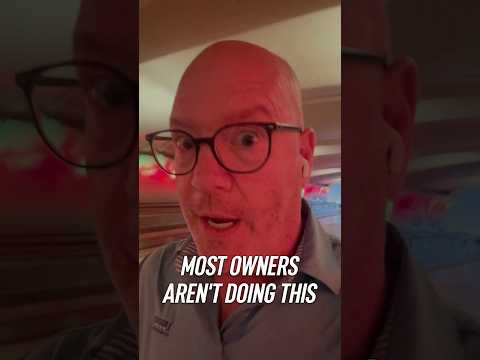
I recorded this Fargo Walks episode on a layover in Detroit, walking to my gate. While I walked, my client follow-ups went out, my content got scheduled and my reporting ran. None of it needed me. That is the whole point of the clip.
Why can't most owners leave their desk for an hour?
Because the morning is made of small recurring tasks that only they know how to do.
Follow-ups, scheduling, reporting, the check-in email, the status update. None of them is hard. All of them are yours. Each one takes ten minutes, and together they take the morning, every morning, and they take it from the one person whose time is worth the most.
The Federal Reserve Bank of St. Louis put a number on what AI gives back. In a November 2024 survey of US workers, published February 27, 2025, Alexander Bick, Adam Blandin and David Deming found "an average time savings of 5.4% of work hours," which they translate as "a time savings of 2.2 hours per week" for someone working 40 hours. That is the average across every kind of worker, most of whom automated nothing. An owner who moves the recurring morning tasks off their plate is not at the average.
What did I actually automate?
Three things first, and they were the three that stole the most mornings.
Client follow-ups. The ones that go out on a schedule after a call or a deliverable.
Content scheduling. Clips and posts queued to go out on their dates whether I am at my desk or in an airport.
Reporting. The numbers I used to pull by hand every morning now land in front of me already pulled.
I have written about how I found which tasks to start with. My sent folder told me, and so did the daily audit I run on my calendar. The links are below. The short version: the tasks that repeat are the tasks that go first.
How do you find out if your business can fly without you?
1. Take the hour
Leave your desk for one hour in the middle of a workday. Do not check in. Write down what broke or what waited.
2. Sort the list
Everything that waited is either a decision or a task. Decisions stay with you. Tasks are candidates.
3. Pick the one that repeats most
Not the biggest. The most frequent. A ten-minute task that happens daily is worth more than an hour-long task that happens monthly.
4. Build it once, from your own records
Give AI the last twenty examples of you doing that task. Your emails, your reports, your follow-ups. It should run from your material, not a template.
5. Take the hour again
Same test, a month later. The list should be shorter. When it is empty, you own a business.
What this does not mean
It does not mean you stop working. It means you stop being the only thing standing between your business and a normal Tuesday.
It also does not mean automating everything. Judgment stays with you. The repeat work is what leaves.
The decision
Take the hour this week. Whatever waited for you is the list. Start with the one that repeats most.
Sources
- Federal Reserve Bank of St. Louis, Alexander Bick, Adam Blandin and David Deming, "The Impact of Generative AI on Work Productivity," February 27, 2025. November 2024 survey; average time savings of 5.4% of work hours, about 2.2 hours per week.
- Jeff Fargo, Fargo Factor Insight: Your Sent Folder Reveals What AI Should Automate
- Jeff Fargo, Fargo Factor Insight: My AI Command Doc Audits Every Workday
- Jeff Fargo, Fargo Factor Insight: What Parts of Your Job Can AI Replace
Transcript
Verbatim from the Fargo Walks clip, as recorded.
I'm working on my business while on a layover in Detroit. Most owners can't leave their desks for an hour. The tasks that I do almost every morning are now automated. They're running right now as I'm walking to my gate: client follow ups, content scheduling, reporting. All of it happening without me. Your business should be able to fly without you. If not, you don't own a business. You own a job that pays you. Go forth.
Jeff Fargo is the founder of Fargo Factor and host of Fargo Talks. Fargo Factor advises established businesses on AI Search Authority, AI Decision Systems, and selective AI-enabled implementation.
WHEN THE DECISION MATTERS
Take the hour. See what waits for you.
Fargo Factor helps established businesses find the recurring work that stops when the owner does, and build it to run without them.