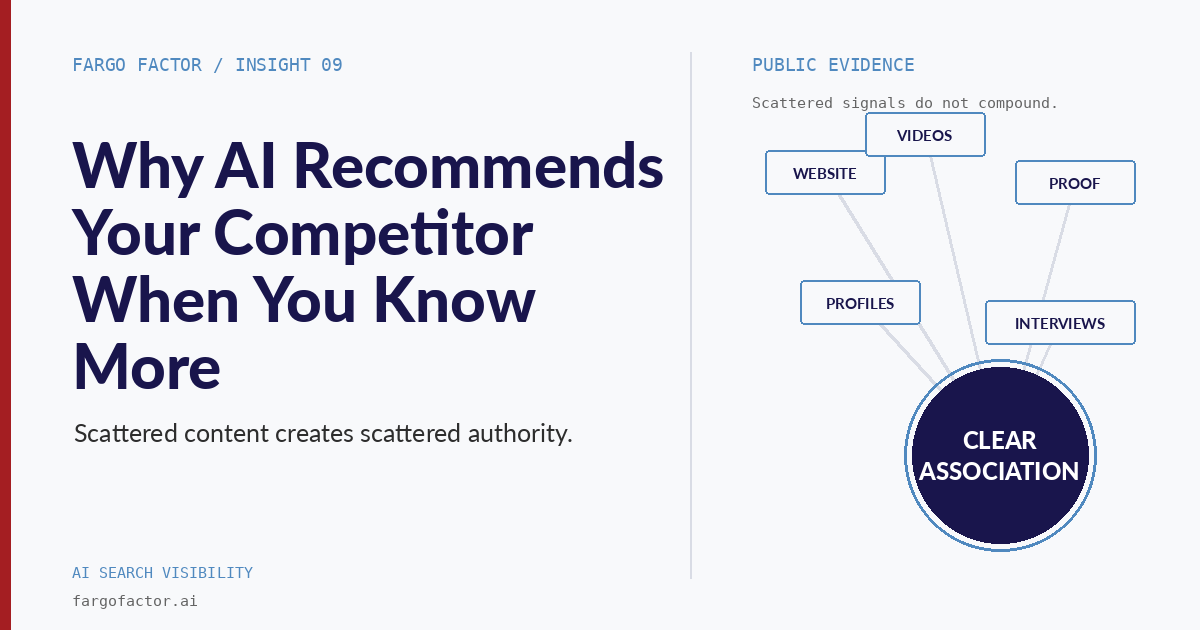
Your expertise is not the same as visible authority
You may know more than your competitor and still lose the recommendation.
AI cannot see the years you spent learning the business, the calls you handled, the mistakes you corrected, or the judgment you apply when the obvious answer is wrong.
It can only work with the evidence it can find, understand, and connect to a question.
That is the point of the source video:
If you are putting out scattered content, you are putting out scattered authority.
The problem is not always a lack of expertise. The problem is that your expertise is spread across unrelated posts, vague service pages, old interviews, inconsistent profiles, and content that never makes one thing unmistakably yours.
Your competitor may know less. Their public evidence may be easier to retrieve and easier to associate with a specific problem.
New evidence: the shift moved ten points in a year
Three weeks after this Insight published, Pew Research Center measured the exact behavior described above.
Forty-four percent of US adults now report using ChatGPT. That is up ten points from a year earlier.
Sixty percent say they read the AI summary at the top of a Google search before they read anything else.
That is the moment where your competitor gets recommended and you do not. It is not a rare moment. It is where most searches already end.
Transcript of this clip
Verbatim, as recorded.
Cameo, Brandy Fargo. What if your customer was searching what you offer on ChatGPT right now? Pew Research confirmed it. Forty percent of American adults are now using ChatGPT. That's up ten percent over last year. Sixty percent of Americans are reading the AI summaries in Google. If you are not being recognized in AI search, your competitor absolutely is. I'm Jeff Fargo. I help businesses get found in AI search. Go forth.
Note on the numbers: the clip says forty percent. Pew Research's published figure is forty-four percent, up from thirty-four percent the year before. The corrected figures are used above.
Stop asking whether your competitor is better
That is usually the wrong first question.
Ask:
What public evidence makes their name easier to connect to the answer?
Google tells site owners to create helpful, reliable, people-first content, demonstrate firsthand expertise, and maintain a clear primary purpose or focus. Google also warns against producing large amounts of content across many topics hoping some of it performs. (Google Search Central: Creating helpful, reliable, people-first content)
For Google’s AI search features, the normal search fundamentals still apply. Pages need to be eligible for indexing, technically accessible, and useful. Google says there is no special AI-only markup that guarantees inclusion. (Google Search Central: AI features and your website)
OpenAI also documents crawler access as part of how public web content can be understood. OAI-SearchBot follows robots.txt rules, and access can still be blocked by firewalls, bot protection, authentication, or other technical controls. (OpenAI: Guidance for allowing web crawlers)
None of that guarantees a recommendation.
It establishes the basic operating reality: private expertise is not enough. Your business needs clear, accessible, consistent evidence tied to a problem a buyer actually asks about.
Pick one problem your business should own
Do not begin with every service you provide.
Begin with one costly, recurring problem that your best client immediately recognizes.
A useful problem has five qualities:
- The buyer knows the problem exists
- The problem has a meaningful cost
- You have real judgment or evidence around it
- The problem is specific enough to explain clearly
- Solving it naturally leads to the work you want
“AI” is not a problem.
“Content” is not a problem.
“Growth” is not a problem.
“Our expertise is scattered across channels, so buyers and AI systems cannot tell what we should be trusted for” is a problem.
That level of specificity gives your authority somewhere to accumulate.
Build one canonical answer
Your website needs one page that gives the clearest version of your answer to the chosen problem.
That page should state:
- The problem: What is happening?
- The consequence: What does it cost in time, money, quality, opportunity, credibility, or judgment?
- The mechanism: Why does the problem keep happening?
- The decision: What should the business do differently?
- The method: What sequence should it follow?
- The evidence: What proves the recommendation is grounded?
- The boundary: What does the recommendation not guarantee?
This is not a keyword page.
It is the page you would send to a serious buyer who asked for your clearest thinking on the issue.
The title, main heading, opening answer, examples, and supporting evidence should all describe the same problem in consistent language.
Turn scattered content into supporting evidence
Once the canonical answer exists, your other content has a job.
Every useful supporting asset should do at least one of four things:
- Answer a narrower question inside the main problem
- Show a firsthand example or failure
- Explain one step in the method
- Add evidence, qualification, or an exception
A video can introduce the idea.
An interview can show judgment.
A case record can document what changed.
A FAQ can address recurring objections.
A comparison can clarify where the method fits and where it does not.
The assets do not need to repeat the same article.
They need to reinforce the same problem ownership.
That is how authority compounds instead of resetting with every post.
Make the business entity consistent
Strong content cannot fully repair contradictory business information.
Check the facts AI systems and search systems may encounter:
- Company name
- Founder or leadership names
- Primary category
- Services and products
- Location and service area
- Website and contact information
- Customer types
- Current positioning
Decide which source is authoritative for each fact.
Then fix the conflicts across your website, business profiles, professional profiles, directories, partner pages, podcast biographies, and public documents.
If the company teaches five different definitions of itself, the public record is asking AI to guess.
Build corroboration you do not control
Your own website is necessary. It is also self-published.
Third-party evidence helps confirm that the business, expertise, and problem ownership are real.
Useful corroboration may include:
- Detailed customer reviews that describe the actual problem solved
- Partner or association profiles
- Podcast interviews and transcripts
- Conference appearances
- Earned media coverage
- Named case records used with permission
- Accurate professional and business directories
Do not manufacture mentions or chase low-quality directory volume.
One credible source that clearly describes what you do is worth more than fifty thin listings repeating vague language.
Measure whether your name is becoming connected to the answer
Do not measure AI visibility with one flattering screenshot.
Create a fixed prompt set around the problem you chose to own.
Include:
- Category questions
- Problem questions
- Comparison questions
- Alternative-provider questions
- Questions about your company
- Questions that verify claims, location, leadership, and capabilities
For each test, record:
- The exact prompt
- The platform
- The date
- Whether your business appeared
- How the business was described
- Whether the answer was accurate
- Which sources were cited
- Which competitor appeared instead
Run the same prompts again after substantive changes.
The goal is not to force one answer.
The goal is to learn which questions your evidence supports, where the public record is weak, and what needs to change next.
A 30-day authority concentration plan
Days 1–3: Choose the problem
List the problems your best clients repeatedly bring to you. Select one that is costly, specific, commercially relevant, and supported by your actual experience.
Days 4–7: Audit the public record
Search the problem across relevant AI and search systems. Review what they say about the category, your company, and your competitors. Save the exact prompts, answers, and cited sources.
Days 8–14: Build the canonical answer
Create one definitive page around the problem. Lead with a direct answer. Add your method, examples, evidence, limitations, and next decision.
Days 15–21: Concentrate supporting evidence
Publish or update a small number of supporting assets. Connect them to the canonical answer. Remove or revise material that contradicts the positioning.
Days 22–26: Strengthen corroboration
Correct major third-party profiles. Capture legitimate reviews, interviews, partnerships, and case evidence that accurately describe the problem you solve.
Days 27–30: Re-test
Run the original prompt set. Compare the descriptions, sources, accuracy, and competitor appearances. Decide what evidence remains missing.
Thirty days is a review cycle, not a promise that external systems will change on your schedule.
The decision
You do not need to become known for everything.
You need to become unmistakably credible for the right problem.
Pick the problem.
Build the clearest answer.
Concentrate your examples, evidence, and third-party proof around it.
Measure whether buyers and AI systems can connect your name to that answer.
Then expand only when the first association is clear.
Frequently asked questions
Why does AI recommend a competitor with less experience?
AI systems cannot evaluate private experience directly. A competitor may have clearer, more accessible, and more consistent public evidence connecting its name to the question being asked.
Should a business publish more content to improve AI visibility?
Not automatically. More disconnected content can increase ambiguity. Start by choosing one problem, cleaning the source truth, building one canonical answer, and publishing supporting evidence around it.
Does owning one problem mean offering only one service?
No. Problem ownership is a positioning decision, not a restriction on delivery. A business can offer several services while making one commercially important problem the clearest entry point.
Can content guarantee recommendations in ChatGPT or Google AI features?
No. External systems control their own crawling, retrieval, ranking, synthesis, and presentation. You can improve the evidence environment and measure the result. You cannot guarantee the answer.
How should AI visibility be measured?
Use a fixed prompt set, record the platform and date, capture whether the business appeared, review how it was described, and save the cited sources. Re-test after material changes.
What should the first authority page contain?
It should define the problem, explain the consequence and mechanism, give a practical decision and method, show evidence, state limitations, and make the business’s expertise clear.
Make your expertise obvious to AI
Fargo Factor helps founders and business owners decide what problem they should own, audit what AI systems can currently find, and build the authority system that connects their judgment to the answer.
The goal is not more content.
The goal is concentrated, credible evidence.
Sources
- Jeff Fargo, Fargo Walks: Why AI Recommends Your Competitor When You Know More
- Google Search Central: Creating helpful, reliable, people-first content
- Google Search Central: AI features and your website
- OpenAI: Guidance for allowing OpenAI web crawlers
- Jeff Fargo, Fargo Walks: AI Is Recommending Your Competitor, Not You
- Pew Research Center: Americans and AI 2026
Transcript
Verbatim from the Fargo Walks clip, as recorded.
Why is AI recommending your competitor when you know more? Well, it's because your expertise is not obvious to AI. If you're putting out scattered content, then you're putting out scattered authority. You need to pick and own one problem that your clientele deals with, and make your name impossible to separate from the answer to that problem. I'm Jeff Fargo, and I can help you get found in AI search. Go forth.
Jeff Fargo is the founder of Fargo Factor and host of Fargo Talks. Fargo Factor advises founders and business owners on AI search visibility, practical AI integration, and decision systems.
WHEN THE DECISION MATTERS
Make your expertise obvious to AI.
Fargo Factor helps established businesses choose the problem they should own, strengthen the evidence AI can find, and build the authority system around it.